
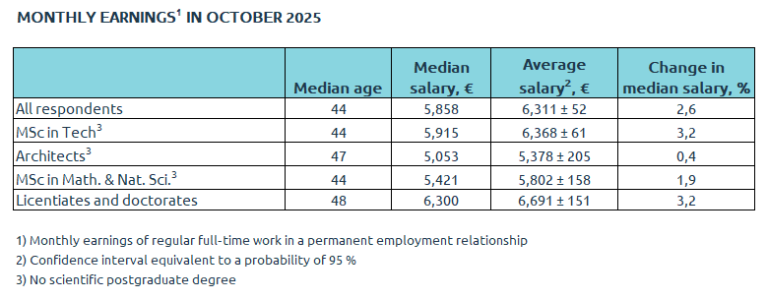
A labour market survey conducted by Academic Engineers and Architects in Finland TEK reveals that permanent employees holding a Master of Science in Technology (diplomi-insinööri) had a median salary of EUR 5,915 and an average salary of EUR 6,368 per month in October 2025. The corresponding salary figures for those who graduated with a Master of Science in Technology in 2025 were EUR 4,000 and EUR 4,193 respectively.
The median salary for employees with a Master of Science in Technology rose by 3.2 per cent on the previous year, and their purchasing power has grown year on year. Graduates with a Master of Science in Technology also saw an increase in their purchasing power in 2024, but real-terms salaries fell in both 2023 and 2022.
"Despite how it may seem, there is no such thing as automatic pay progression. In reality, TEK has to bargain with employer unions on behalf of its members to ensure that collective agreements provide annual pay increases. The collective bargaining we do represents real value for money and unbeatable customer service for our members," says Labour Market Director Teemu Hankamäki from TEK.
"Regular pay rises more than make up for the cost of union membership, and there would be essentially no pay progression without the bargaining efforts of trade unions such as TEK. We naturally also have members who qualify for merit increases, salary raises initiated by an employer unrelated to collective agreements, but merit increases are actually relatively rare in practice."
Increasing members’ purchasing power is always at the top of the agenda during salary negotiations, according to Hankamäki. Purchasing power is a measure of the quantity of goods and services that a person can purchase with their income.
It appears that this year’s salary increases will finally give TEK’s members a proper boost in terms of purchasing power.
"The collective agreements negotiated by TEK secured total increases of approximately 2.5 per cent for our members last year. With annual inflation at just 0.2 per cent, it is clear that our members’ purchasing power has grown. Inflation is forecast to remain about 1.5 per cent this year, which, combined with collective agreements delivering pay increases of 2.9 per cent, promises to bring a rapid rise in purchasing power in 2026," Hankamäki explains.
Hankamäki wants people to remember that the recovery of purchasing power appears to be boosting the national economy as a whole and that recent pay rises are not expected to result in a self-perpetuating cycle of inflation and accelerating price increases.
"Everyone, including those who were outraged and vehemently opposed to contractual increases last spring, is now counting on these signs of recovery in the Finnish economy."
Most pay rises are across-the-board raises
Of respondents who were employed on a full-time basis, 83 per cent reported that their salary had increased since the previous year. In total, 10 per cent said that their salary had remained unchanged and 3 per cent reported a drop in their salary.
Across-the-board raises, also called general increases were by far the most common type of pay rise. Of respondents whose salary had increased, 77 per cent reported that their pay rise was based on a general increase provided for in a collective agreement. A total of 17 per cent of respondents who had received a pay rise said that their raise had been initiated by their employer based on an applicable collective agreement.
A total of 19 per cent of respondents whose salary had increased had received a so-called merit increase based on personal performance.
Salaries increased by approximately 2.5 per cent in many industries in 2025; some of these increases were general raises while others were employer initiated. The way in which the issue of pay is dealt with varies from sector to sector, and there are also local agreements.
About the survey
The data collection phase of the labour market survey ran from October to November 2025, and the target group consisted of members of Academic Engineers and Architects in Finland TEK who were active in the labour market. Approximately 9,300 people answered the survey, and the response rate was around 20 per cent. The majority of the respondents were employed in professional and managerial roles in the private sector. The most commonly obtained qualification among the respondents was a Master of Science in Technology (diplomi-insinööri).