
Trade unions form a core part of the labour market system in Finland. Together with employer organisations and the state, they negotiate the so called collective agreements (‘työehtosopimus’, often shortened to ‘tes’ in Finnish).
What is the role of collective agreements in daily work?
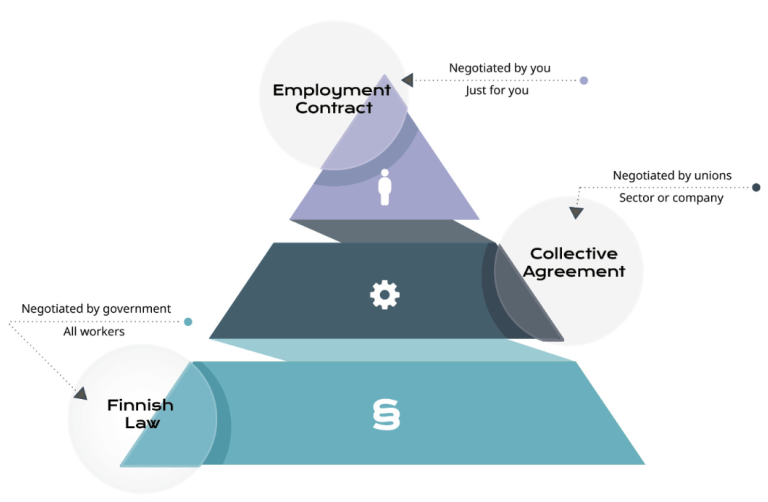
When working in Finland, there are three levels of protection underneath you. On the bottom level is the law, which governs the most basic of rights and conditions, setting minimum baselines for every employee in Finland. On the top level is your employment contract, which is specific to yourself and in a high level of detail.
In between these two levels are collective agreements. Just as your contract cannot contain anything against the law, it also cannot break the relevant collective agreement.
(The article continues after the image.)
The agreement contains information such as the lengths of paid sick or parental leave, entitled holiday benefits, and what compensations for travel are owed. Together these are of huge importance, both to the finances and to the wellbeing of workers. The collective agreement also includes the length of a workday, and hence when extra pay must be rewarded for overtime. In law, this is set to 40 hours per week.
Perhaps most crucially, the collective agreement contains the only guaranteed salary rise for employees. TEK’s research shows the importance of these rises well. In the 2025 Labour Market Survey, 83% of respondents reported their salary had increased from the previous year. Of these, 77% said this pay rise was due to the flat general increase listed in the collective agreement. Read more in this article.
Who negotiates?
These agreements are negotiated between employer and employee union negotiators (for TEK, this means YTN for the private sector and JUKO for the public sector). Negotiators are typically union employees, and multiple unions therefore work together in collective bargaining. The agreements negotiated also benefit non-union members.
Increasingly, agreements may instead be negotiated at company level (company specific agreements). Ideally, these should build on the collective agreement conditions in a way that better suits the workplace.
For most employees, it is hard to notice this system happening, because strikes are incredibly rare, especially for unions with highly educated members such as TEK. Negotiations generally lead to successful results because of the high unionization in Finland.
Who to ask?
Shop stewards act as the eyes and ears for the collective agreement negotiators within workplaces. They also represent the senior salaried employees ('ylempi toimihenkilö') of the workplace in all matters related to the employment relationship and in issues relating to the application of the collective labour agreement. For employees, they are a vital point of contact about workplace concerns.
If you have any questions about your employment or workplace, you’re welcome to turn to the shop stewards or TEK’s work life experts.
Source on the percentage of Finland's unionization: Statista.com
Land of unions
Being a member of a trade union is both common and non-stigmatizing, meaning it does not come with the negative “disruptor” connections that can be seen in many countries around the world. Membership is, however, confidential.
Finland has more than 65 trade unions. They are grouped based on the type of work their members do into three main confederations: Akava, STTK and SAK. TEK is a part of Akava, which represents unions for people with different higher‑education backgrounds. This system of confederations further allows for combined voices and unity among workers.