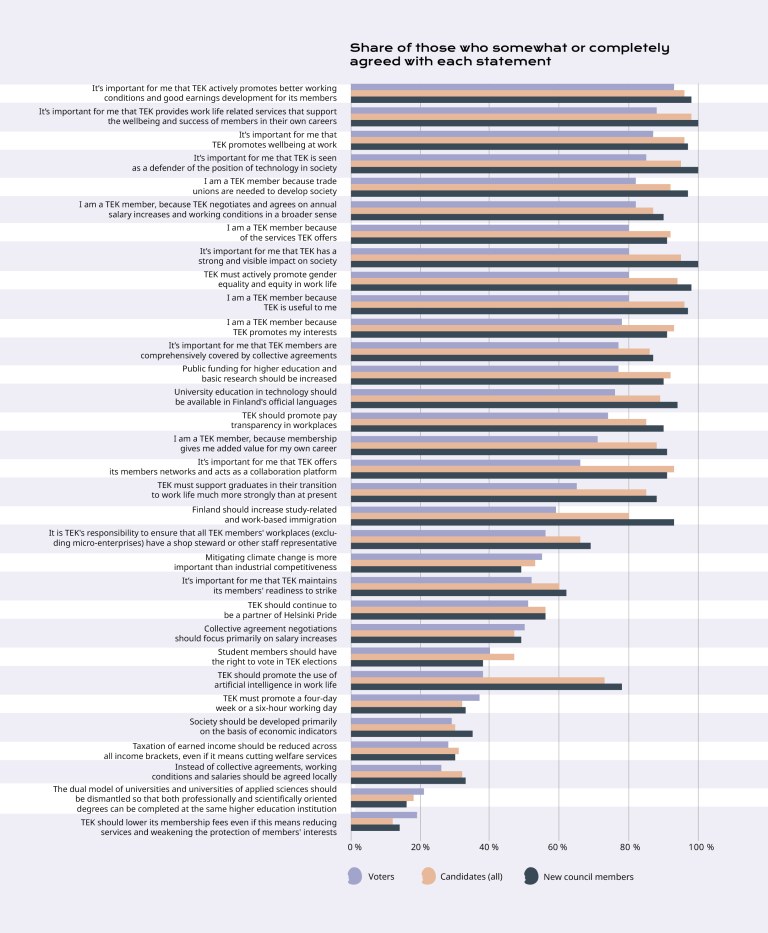
The responses to the election compass for the spring council election of Academic Engineers and Architects in Finland TEK show that voters, candidates and the newly elected council are largely aligned. The accompanying chart shows the share of positive responses – that is, responses in which participants somewhat or completely agreed with each statement.
(Article continues after the image.)
Download the image as a pdf here
For voters, the highest priority is that TEK actively promotes better working conditions and strong earnings development for its members. The second most important priority is that TEK provides working life services that support members’ wellbeing and career success.
The third most important issue for voters is that TEK promotes wellbeing at work. The fourth is that TEK is seen as a defender of the field of technology in society. Fifth most commonly, respondents agreed that they are members of TEK because trade unions are needed to help develop society.
The views of election candidates and those elected to the council differed slightly from those of voters, mainly in that they expressed even stronger agreement with the statements.
According to Juhani Nokela, TEK’s Director of Public Affairs, the election compass worked exactly as intended by highlighting differences between candidates.
“As always, there has been criticism of the questions and their emphasis. But, as in any well-designed election compass, candidates had the opportunity to explain their views to voters in their own words,” Nokela says.
Did anything in the responses surprise you?
“Although the atmosphere of societal debate has become increasingly polarised, I have not observed similar polarisation in the work of TEK’s council or its other representative bodies in recent years. I believe the new council will be able to see differing opinions as a strength as we build a better TEK together for all members.”
Some differences emerged
One statement clearly distinguished voters from both candidates and those elected to the council. Voters considered it far less important that TEK should promote the use of artificial intelligence in working life. Fewer than 40 per cent of voters somewhat or completely agreed with the statement, while more than 70 per cent of candidates and those elected to the council held this view.
The statement “Finland should increase study-related and work-based immigration” also received considerably stronger support from candidates and elected representatives than from voters.
By contrast, voters placed greater importance than candidates and elected representatives on the statement that “Mitigating climate change is more important than industrial competitiveness.”
The same pattern appeared in the statements “Collective agreement negotiations should focus primarily on salary increases” and “TEK must promote a four-day week or a six-hour working day”.
Voters were also more supportive of dismantling the dual model of universities and universities of applied sciences so that professionally and academically oriented degrees could be completed within the same higher education institution. They were likewise more supportive of lowering TEK’s membership fee, even if it meant reducing services and weakening collective representation.
Relevance of the questions divided opinions
Most people who used the election compass found it useful. Sixty-six per cent of respondents considered the questions relevant, while 20 per cent were dissatisfied.
The remaining respondents took a neutral view of the statement that the election compass questions had been relevant to them. A total of 3,916 people responded.
Fifty-two per cent said that they used the election compass as the basis for choosing a candidate. Nine per cent said that they did not, while the remaining 39 per cent responded neutrally to the statement that they chose their candidate on the basis of the election compass.