1. Before the interview
Waiting until the night before to start preparing for a job interview is not a good idea. TEK’s career coach Katja Sulenko recommends keeping a copy of the job posting and going through the posting as well as your CV and application letter again before the interview.
‘Remind yourself of the selling points that you have brought up and highlighted in your application and your CV. The interviewer is likely to want to hear more about them’, Sulenko says.
If you have applied for several jobs, having copies of the job postings helps you to remember the key features of the position for which you are interviewing.
TEK’s Head of Career Services Sari Haataja-Helander recommends reminding yourself of what it is that you want the interviewer to know about you as a person, your skills and your motivation.
‘It is important not to waste time talking about skills and experience that are not relevant to the position in question.’
Sulenko suggests identifying three key points that you want to get across and making sure to bring them up at the interview even if the interviewer does not ask about them.
'Concrete examples are super!’
Bear in mind, however, that examples of what you have achieved on your current employer’s payroll could be considered confidential information.
Haataja-Helander also recommends practising your pitch with a friend. Finding the right words can be difficult in a high-pressure situation such as a job interview. You can also record yourself as you practise answering questions and watch the recordings back to examine your body language and facial expressions.
You can even try sparring with artificial intelligence. Sulenko suggests giving your AI assistant the role of the interviewer. AI can be useful for practising answering typical interview questions and getting constructive feedback on your answers.
‘Prepare a few questions of your own to ask the interviewer. You may want to know more about the team or the organisation’s way of working, for example. Questions about the position for which you are interviewing give you more information about the job description: what will be expected of you and what kinds of goals or challenges are associated with the role. Asking questions of your own shows the interviewer that you are genuinely interested in the position’, Haataja-Helander says.
Interviews are an important part of the recruitment process. The idea of a job interview can be daunting, but being well prepared helps to build confidence.
‘The interviewer will understand that you are nervous. Ultimately, they also want you to do well.’
2. During the interview
According to Sari Haataja-Helander, modern job interviews come in many forms and there may be multiple rounds of interviews. There may be, for example, first a short remote interview for a larger group of candidates or a pre-recorded (one-way) video interview, which involves candidates recording their answers to pre-set questions on video. This may be followed by a more technical interview round or an interview with your potential future colleagues – or you may be offered an opportunity to prepare a concrete work sample to demonstrate your skills in practice.
‘The circumstances of the interview may be different from what you expected. It is important to keep an open mind,’ Katja Sulenko says.
According to Sulenko, job interviews usually start with casual conversation. The interviewer may, for example, talk a little about the organisation and the position for which you are interviewing.
Haataja-Helander points out that you should not expect the interviewer to have memorised the details of your job application and CV. Make sure to get your most important points across during the conversation and elaborate on what you mentioned in the application.
‘In a perfect world, a job interview is a two-way street, but every interviewer has their own style’, Haataja-Helander says.
‘The purpose of a job interview is to establish an interactive dialogue that allows both parties to learn more about each other and evaluate whether the candidate and the position are a good match’, Sulenko adds.
One of the issues that got participants talking on TEK’s Onnistu työhaastattelussa (‘Excel at Interviews’) online course was the appropriate length of an answer at a job interview. Practising your pitch helps you to keep your answers short and to the point.
‘Keep the most important points that you want to get across at the forefront of your mind – this way you will make the most of the limited time that you have with the interviewer,’ Haataja-Helander says.
Your answers should ideally communicate to the interviewer what you have learned on your career so far, what you would bring to the organisation and how you see yourself evolving professionally in the future. There may be elements in the job description of the position for which you are interviewing that are new to you.
‘Instead of perfection, recruiters often look for the best match’, Sulenko says.
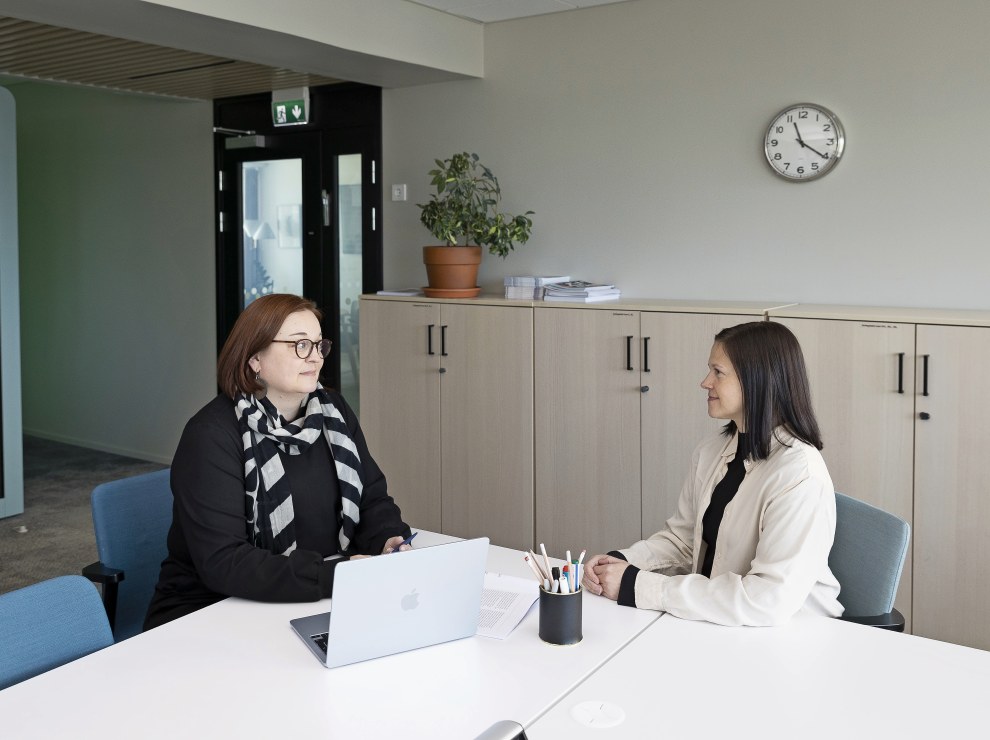
Top tips for acing interviews. According to career coach Katja Sulenko (on the right), interviewers are not looking for a flawless performance – remember to be yourself and that it is fine to ask for a moment to gather your thoughts if you need time to formulate your answer. Head of Career Services Sari Haataja-Helander recommends having a clear idea of what you want to get across about your skills, work experience and motivation.
3. After the interview
Job interviews usually end with the interviewer summarising the next steps in the process and explaining how and when the employer will make their decision. According to Katja Sulenko, sending a thank-you message to the interviewer can be a nice touch – although there is no rule that you have to.
Sulenko also recommends reflecting on the interview afterwards: how did the conversation go and how do you feel about the position now based on the interview.
‘Over-analysing your performance is not helpful, however. A job interview is always a sum of its parts, and the employer’s decision rarely comes down to one specific answer’, Sari Haataja-Helander says.
If you do not get the job, you can get in contact with the interviewer and ask for feedback. You can also express your interest in other opportunities that may open up in the future.
‘Remember that being invited for an interview means that the organisation is interested in your skills. Just getting your foot in the door is a win’, Sulenko says.
‘Something else may come out of your meeting even if you do not get that particular job’, Haataja-Helander adds.
Practice your answers with TEK's interview game
As a TEK member, you can also familiarise yourself with typical interview questions in Finnish
See the Onnistu työhaastattelussa ('Excel at job interviews') online course in Finnish