
“The purpose of a job application is capture the employer’s interest,” says TEK's career coach Minna Vallinrinne.
She compares the job search documents: The CV describes the applicant’s accumulated experience and expertise. The application explains how the applicant can put these to use in a new role.
TEK's career coach Markus Lindholm has been advising jobseekers for several years. Many people ask what makes a good structure for a job application. Lindholm says it usually comes down to three parts: motivation, skills for the specific job, and what you are like as an employee.
“The application is your opportunity to explain why you are applying for the role and why you are suitable for it,” he says.
According to Lindholm, applicants should give serious thought to what exactly it is about the job that inspires them to apply.
The applicant’s motivation is important to the employer as well. According to Vallinrinne, the more motivated employees are, the more likely they are to be satisfied with their work and committed to the employer. Your motivation also shows a desire to learn and develop.
It is a good idea to customise your application and CV to match the job posting every time you apply for a new position.
“Analyse the job posting. What are the requirements of the role? What qualities does the employer want the applicant to have? Your application should respond to them. Link your skills and experience to the job you are applying for,” Vallinrinne advises.
It is OK to praise yourself in a job application.
“You need to be able to say, ‘I am good at this.’ Of course, it must also be true, so you should be able to justify your claims. Superlatives are not convincing. You may be as absolutely outstanding and one-of-a-kind as possible, but make sure you give some concrete examples of it,” Lindholm says.
Lindholm recommends the STAR model as a practical way to present a concrete example: Situation, Task, Activity, Results. In other words, describe the initial situation and describe your key responsibilities and goals. Then tell what you did to reach your goals and what kind of results you achieved. Describe the benefits of your actions.
According to Vallinrinne, an experienced recruiter can recognise an application written by artificial intelligence, so it is not worth relying entirely on AI. However, it can be utilised if you are having trouble getting started with the application or if you need help refining a specific section, for example.
Lindholm agrees.
“The key issue is that artificial intelligence does not know your motivation or plans for the future. You should not allow it to hallucinate and invent them because you will end up with something generic or untrue,” he says.
“Artificial intelligence could be useful for analysing analyse job postings.”
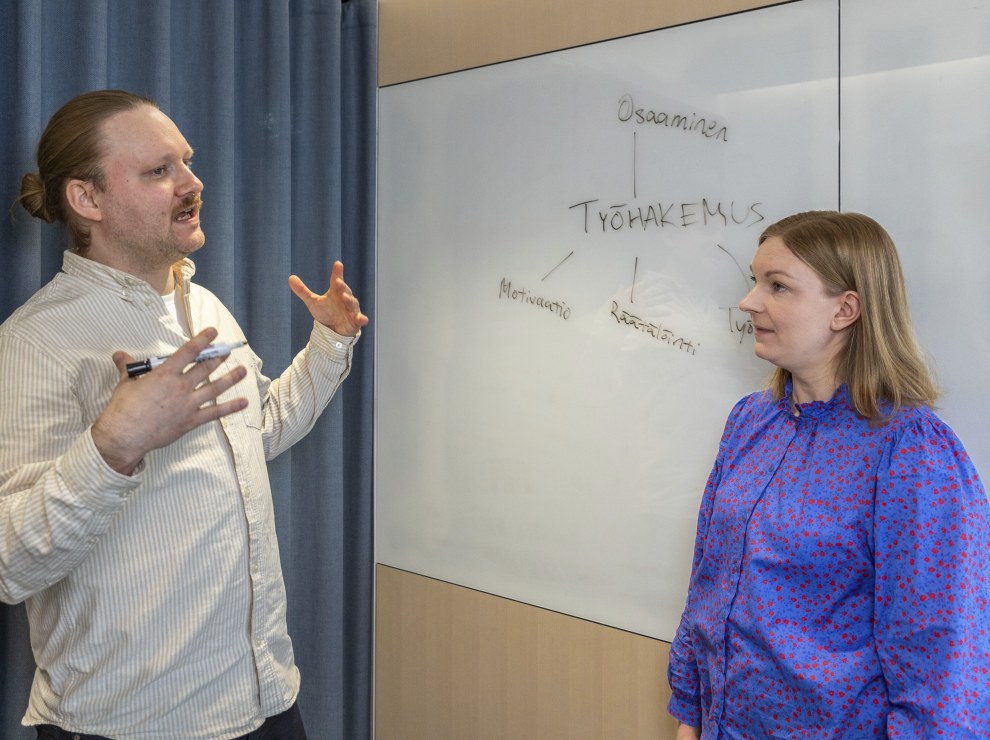
An effective appearance. TEK’s career coaches, Markus Lindholm and Minna Vallinrinne, say that a concise, easy-to-read letter format makes for a well-laid-out application. The application should be consistent in appearance with the CV; for example, the fonts should be the same. Refrain from overusing bulleted lists.
Writing tips
- Get straight to the point.
- Use the same language as the one used in the job posting.
- Your text does not need to be rigidly formal: let your personality shine through.
- Make sure the text is easy to read, the paragraphs are concise, and your application fits on one page.
- Use a clear font.
If the text is added to an application template on the website, no heading is needed.
As a member of TEK, you can get help from the Salary Surveyor, salary statistics, and salary advice: www.tek.fi/salary
No other contact details are required in the application letter, provided they are included in your CV.
TEK members, check out these:
- Online training: polish your CV and application
- Online training: Recognise and communicate your skills
- Example applications, specifically for students: TEK's Workbook
- TEK Magazine, 1/26: A functioning CV is story-based and tailored