
The figures from Akava Works’ Working Conditions Survey paint a bleak picture of what working life looks like for the highly educated workers. Almost 40% of the respondents estimated their risk of burnout to be somewhat high or high. One fifth of the respondents said that they recover from work poorly or somewhat poorly. Approximately 25% of the respondents said that mental problems have a somewhat significant or significant impact on their performance at work.
Approximately 2,000 highly educated salary earners representing Akava’s member unions responded to Akava Works’ Working Conditions Survey. Of the respondents, approximately 240 were members of TEK. Although the number is relatively small, the respondents represented TEK members relatively well in terms of social variables, such as gender, age group and employer sector, so the figures can also be used to draw conclusions on TEK members’ wellbeing at work.
Let’s focus on the good news first: TEK members experienced fewer problems than other Akava members. 27% of TEK members who responded to the survey said that their risk of burnout is somewhat high or high compared to 38% of all respondents. 12% of TEK members said that they recover from work poorly or somewhat poorly compared to 20% of all respondents. 19% of TEK members said that mental health problems have a somewhat significant or significant impact on their work performance compared to 26% of all respondents.
According to Akava Works’ Working Conditions Survey, relatively speaking most problems were reported by those working in the public sector, which probably explains the slightly better situation of TEK members, as most TEK members work in the private sector. The Working Conditions Survey also shows that women experience more stress than men. Women account for about 25% of all TEK members, which might also explain TEK members’ slightly better situation compared to all Akava members.
Then the bad news: these figures, too, are too high. What causes stress at work for TEK members? Some answers are provided in the graph below.
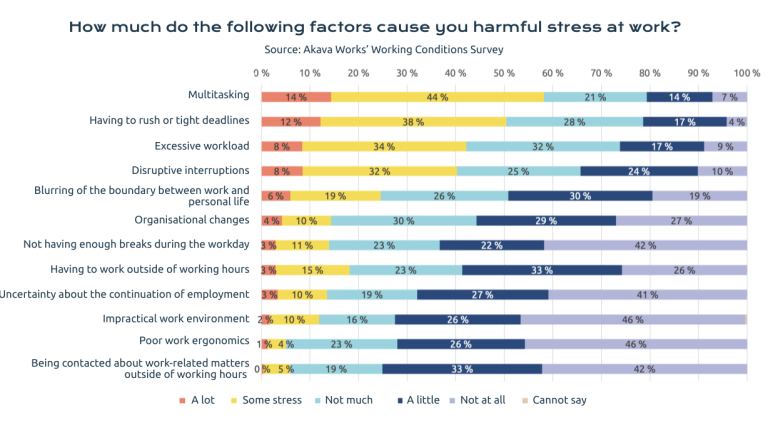
The most harmful stress is caused by multitasking and having to rush or having tight deadlines, as at least half the respondents selected ‘A lot’ or ‘Some stress’ for these options. The next most significant causes of stress were excessive workload and disruptive interruptions, which caused a lot of or some harmful stress for at least 40% of the TEK member respondents. Blurring of the boundary between work and personal life caused at least some harmful stress to 25% of the respondents.
Poor work ergonomics and being contacted about work-related matters outside of working hours, on the other hand, did not cause much harmful stress; 95% of TEK members selected ‘Not much’, ‘A little’ or ‘Not at all’ when asked how much these factors cause them harmful stress.
Joining forces to tackle harmful stress
Harmful stress is one of the most difficult problems in working life, as the figures above show. The top three, or multitasking, tight deadlines and excessive workloads, may not sound too bad if one of them occurs only rarely. However, in STEM fields it has been known for some time now that workers often or constantly face one or several of these problems.
In terms of the work community, excessive workload means that the factors that make work stressful are not under control or that workers are under unequal workloads. Even though the employer is responsible for addressing the issue, causes of excessive workload identified as part of the collaboration between the employer and employees and the efforts to prevent excessive workload will produce the best results in the short and long term. It is important that the impacts of the quality, quantity and intensity of stress at work are frequently monitored, discussed and reported. This makes it possible to keep partial and cumulative stress under control and to take preventive actions faster and more easily.
All workplaces have different employees, which is why workers experience harmful stress differently. Employees may not find the same things stressful, but tools must be provided for all employees to reduce harmful stress. All employees should be aware of their causes of stress, get help in the workplace and learn how to manage stress.
Tuunia Keränen, the co-author of the article, works as a salary researcher at TEK. She studies the salaries and working life of TEK members.
Sirkku Pohja, the co-author of the article, works as a work life expert at TEK. She has extensive experience in promoting equality, non-discrimination and occupational safety at work.
Suitable workload supports wellbeing at work, helps focus on work, maintains work motivation and promotes productive work.
Excessive, monotonous and long-lasting workload and not being able to properly recover from work contribute to the development of harmful stress.