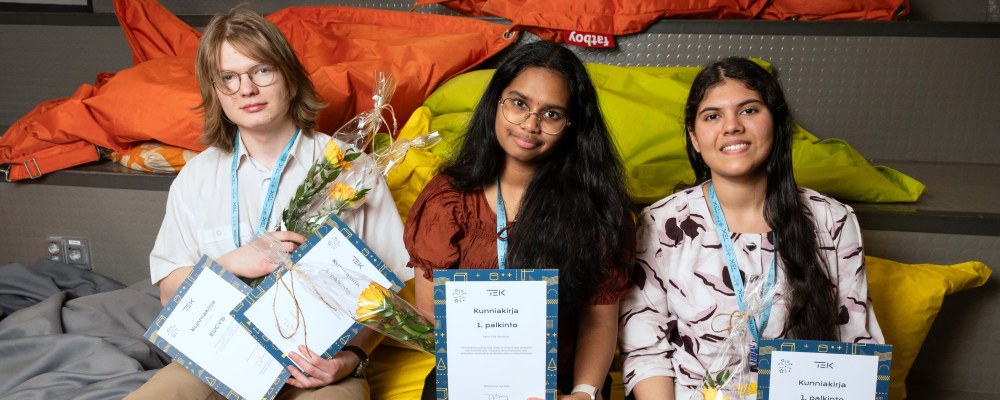
The victory in the Kipinä science competition for young people was shared by Swara Pandharkar, Sahana Suresh and Tommy Kroon. They will represent Finland at the EU Contest for Young Scientists (EUCYS) in Germany in September.
Each of the three winners will receive €1,500 for their individual projects, as well as a place in the EUCYS competition. The Kipinä finale took place on 16 April 2026 at Otaniemi in Espoo. The competition was organised by Academic Engineers and Architects in Finland TEK.
Second prize went to the project by Hossein Zakariaee and Viktor Immonen (€900). Samu Mäkiaho placed third (€600). The remaining projects received honourable mentions (€300 each). In addition, special prizes awarded by TEK were presented.
The Climate Detectives Special Prize, which is the participation in the Climate Detectives Summit in Italy, was awarded to Iqra Asif, Anna Litkey and Migle Bareisyte.
– Our aim is to inspire young people to pursue engineering and the natural sciences, to explore and make discoveries, says Tuula Pihlajamaa, TEK’s youth projects manager and organiser of the Kipinä competition.
A total of 16 different projects created by 20 young participants competed in the Kipinä finale. In total, 81 projects were submitted to the competition.
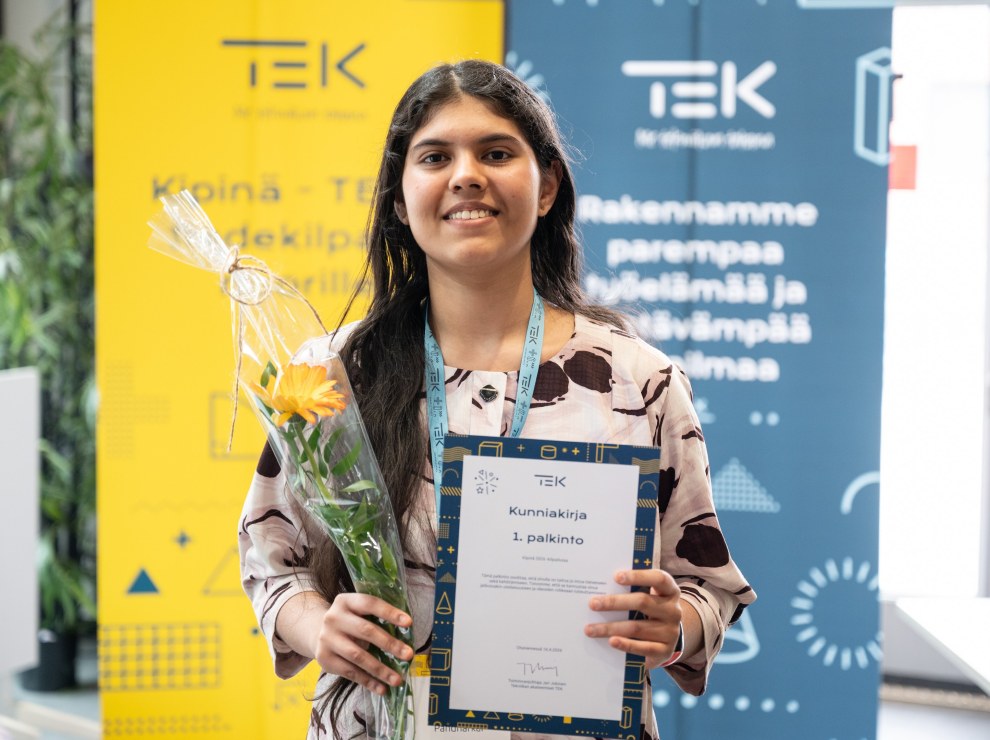
The winning project by Swara Pandharkar (17) is titled “Exploration of a hydrogel’s mechanical properties for biomedical applications”. Pandharkar studies at SYK in Helsinki. The results of the project are not yet public.
Read more about the other two winning projects below.
More durable enzymes for medicine
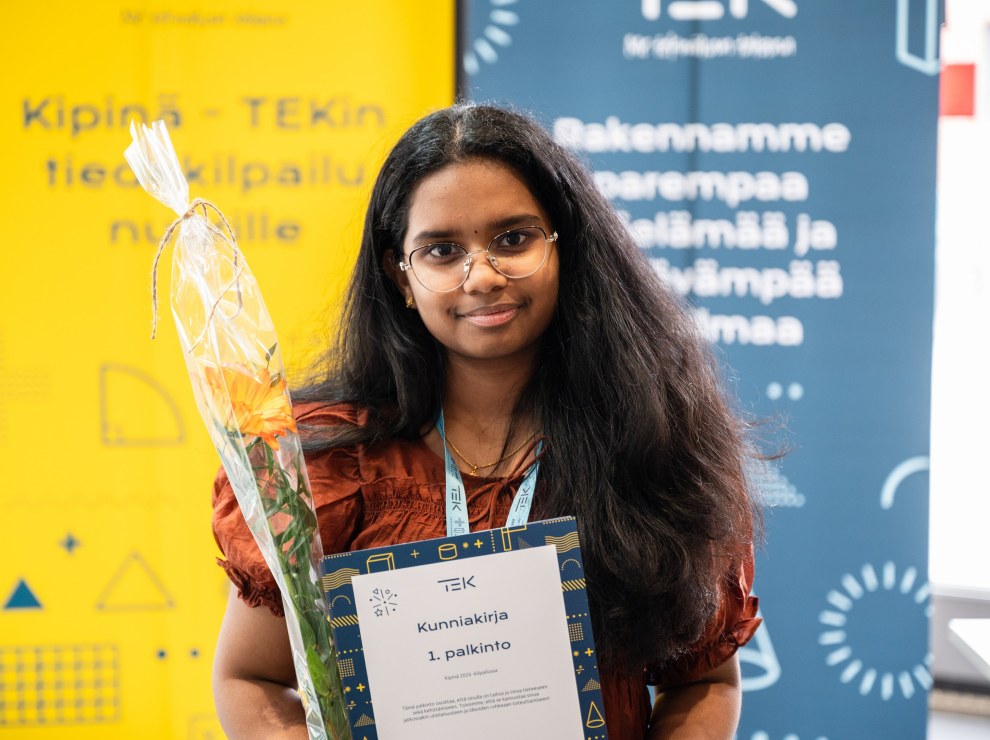
The winning project by Sahana Suresh (17) belongs to the biology category and is titled “Comparing thermophilic and mesophilic amylases and how they can be used to improve therapeutic enzyme stability.”
Suresh compared enzymes that tolerate high temperatures, found for example in hot springs, with enzymes that function at moderate temperatures, such as those found in human saliva and the pancreas. Enzymes accelerate chemical reactions, but changes in temperature, salinity and pH levels can impair their activity. Suresh examined the structural and functional differences between the two enzymes, and how their properties affect enzyme durability and use in medical applications.
Suresh studies in the IB programme at Ressu upper secondary school in Helsinki.
A Model that calculates and predicts salmon numbers
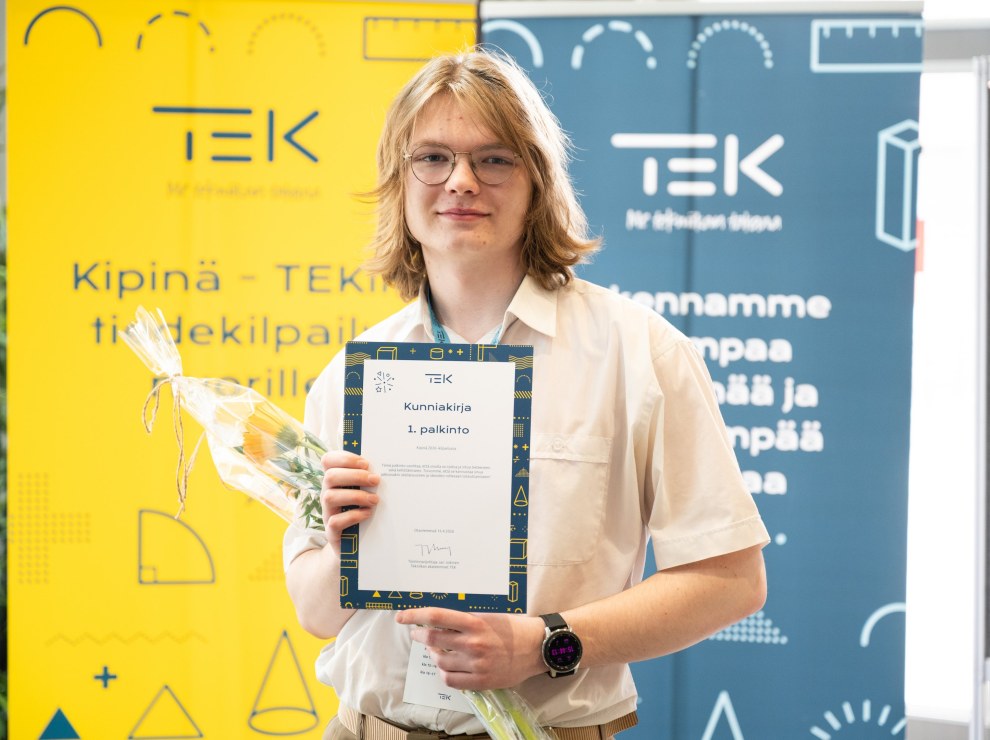
The winning project by Tommy Kroon (18) falls under the environmental category and is titled “Computational modelling of salmon migration in the Tornionjoki river.” (Orig. Tornionjoen nousulohien laskennallinen mallintaminen)
Kroon’s work is linked to public concern over the decline of migrating salmon in rivers flowing into the Gulf of Bothnia. Kroon developed a computational model to estimate the annual number of salmon migrating into the Tornionjoki river and to provide some predictive capability. The model takes into account the effects of fishing and seals on salmon populations.
According to the results, good salmon years are ahead, but for example the impact of changes in fishing quotas would only become visible after a delay of about seven years.
Kroon studies at Päivölä Institute and Tietotie upper secondary school in Valkeakoski.
More information about the Kipinä competition
See all award-winning projects from the Kipinä 2026 competition.