The more regularly you discuss your salary with your supervisor, the higher are your chances of getting a personal pay rise, or a ‘merit increase’.
A merit increase is a pay rise based on personal performance.
A recent labour market survey by Academic Engineers and Architects in Finland TEK asked respondents how often in the last year they had talked to their supervisor about their pay. The survey revealed that 28 per cent of those who regularly discussed their salary with their supervisor had received a pay rise, while the figure was 18 per cent among those who had broached the subject sporadically and seven per cent among those who had not brought up the topic at all.
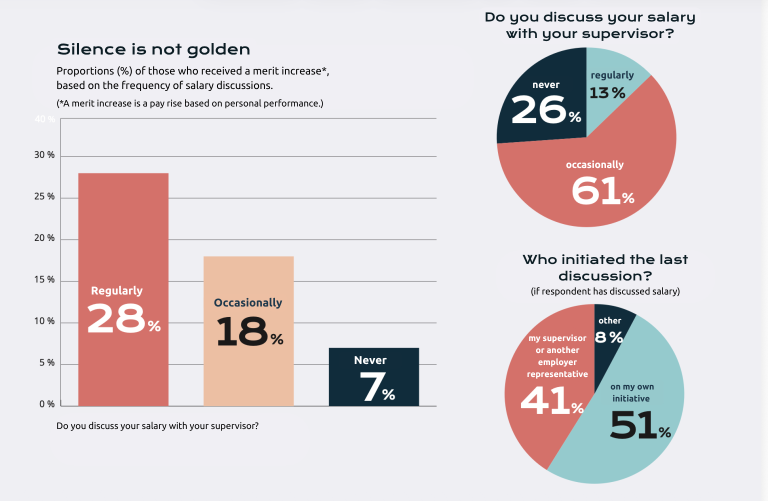
‘Regular chats about pay with your supervisor therefore quadruple your chances of getting a merit increase compared to never bringing up the issue of salary. Speaking up about your remuneration really is worth it’, says TEK’s Salary Researcher Tuunia Keränen, who coordinated the survey.
All in all, 16 per cent of the respondents had received a merit increase in the last year. A total of 68 per cent had received a so-called general increase, which is a pay rise of a set amount based on the applicable collective agreement.
According to the survey, respondents who had discussed their salary with their supervisor had received bigger pay rises than those who had not mentioned the topic at all. The median pay rise given to those who had spoken to their supervisor about their remuneration regularly or sporadically was EUR 200 per month, whereas those who had not had any such conversations had received a median pay rise of EUR 150.
Readiness to discuss pay rises wanes with age
Gender does not appear to affect how likely an employee is to bring up the topic of remuneration with their supervisor.
Age, on the other hand, appears to make a difference.
Respondents aged between 30 and 39 years had been the most forward with their salary expectations. In this age group, 80 per cent had talked to their supervisor about their pay at least sporadically. The figure was 77 per cent among respondents aged between 20 and 29 years, 76 per cent among respondents aged between 40 to 49 years, 70 per cent among respondents aged between 50 to 59 years and just 64 per cent among respondents aged between 60 and 69 years.
Tuunia Keränen encourages people to speak up about their expectations more often, as regular communication of this nature is useful even if it does not lead to a pay rise. Understanding where you stand reduces dissatisfaction.
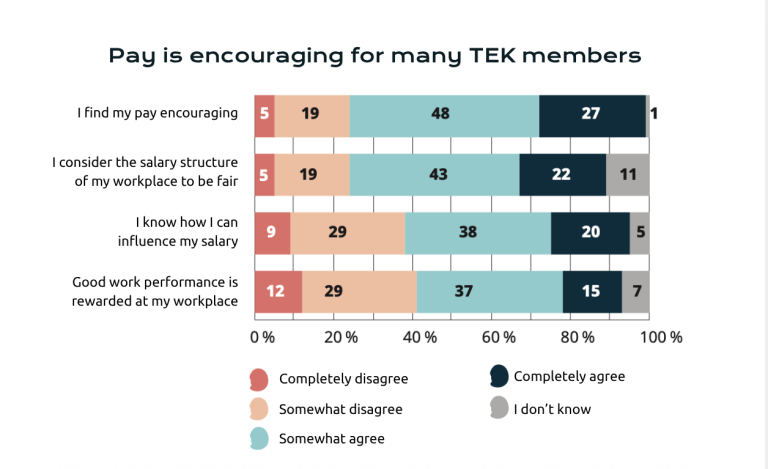
‘Talking to a supervisor about remuneration gives insight into how one can influence pay as well as reassurance that the employer in fact does reward good performance. This makes the remuneration system feel fairer.’
Pay transparency is a welcome change
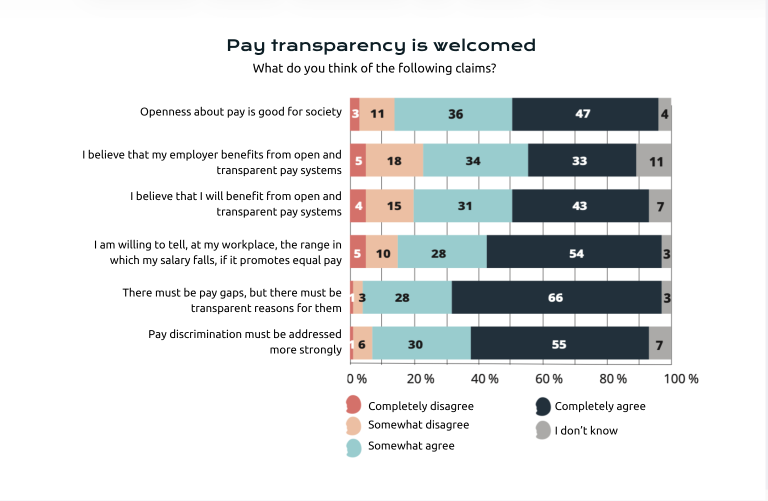
This most recent labour market survey was also the first time that all TEK members were asked about their views on pay transparency. The great majority of TEK members agree that pay transparency is good for society.
TEK members also believe that both they and their employers benefit from transparent remuneration systems.
‘I was actually slightly surprised by the level of support for transparency’, Keränen admits.
The respondents did, however, feel that not everyone’s salary should be public information and that not everyone needed to know everyone else’s salary.
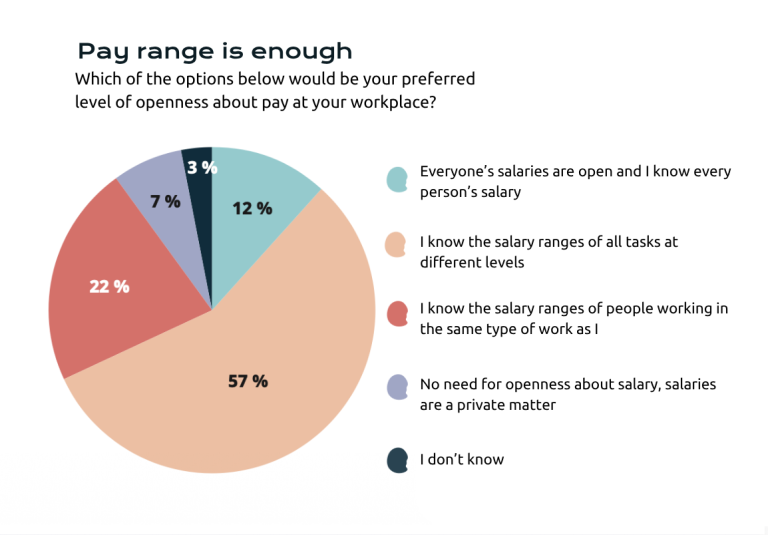
Most felt that the right level of transparency is for everyone to know the salary brackets associated with the various competence levels. Seven per cent of the respondents felt that pay transparency is not necessary and that salary is a private matter.
How much of a pay rise should you ask for?
Salary Researcher Tuunia Keränen from Academic Engineers and Architects in Finland TEK is also one of TEK’s many salary advisors. Between 500 and 600 members turn to TEK for personal salary advice every year. Around 12,000 members also use the Salary Surveyor tool to find out how much they can expect to be paid.
Here are Tuunia’s answers to some frequently asked questions.
How much of a pay rise should I ask for?
‘Our statistics show that the average performance-linked pay rise for TEK members is 300 per month. The average increase for people who change jobs within the same organisation is EUR 500. Going to work for a different employer increases TEK members’ salary by EUR 800 per month on average.’
How often is it okay to ask for a pay rise?
‘I would recommend raising the issue of remuneration approximately once a year and whenever there are changes in your job description. It is also important not to push for another increase too soon after a pay rise.’
What if the employer says no? Is it okay to sulk for a year?
‘I would not recommend it. Every discussion about remuneration is a negotiation. Instead of getting upset, a more productive approach would be to ask what you can do to earn an increase.’
What reason should I give for wanting an increase? Can I use a colleague’s salary as a benchmark for my request?
‘It is best to focus on your own circumstances and to think about what you have done recently that could prove to your employer that you deserve an increase. Valid reasons for a pay rise include, for example, the addition of responsibilities, improved personal performance and new qualifications. Make sure that you are able to give concrete examples. If you are clearly underpaid compared to a colleague, it is naturally worth asking why this is.’
Performance bonuses feel somewhat encouraging
Of the respondents who worked full-time, 53 per cent said that they were entitled to performance bonuses. Of these, 59 per cent felt that the performance bonus system was very or somewhat encouraging.
Performance bonuses appeared to incentivise senior management the most, middle management the second most and employees in expert positions the least. Senior managers were also the most likely to feel that they could influence the size of their bonus through their personal performance.
‘This could be because senior managers tend to get bigger performance bonuses. Experts may well feel that their personal performance makes little difference if, as is often the case, the targets are abstract and not directly linked to their day-to-day work’, Tuunia Keränen explains.
Performance bonuses are also more frequently offered to managers than to experts. Of the respondents who worked in senior management, 68 per cent were entitled to performance bonuses, while the figure was 64 per cent among middle management and 48 per cent among experts.
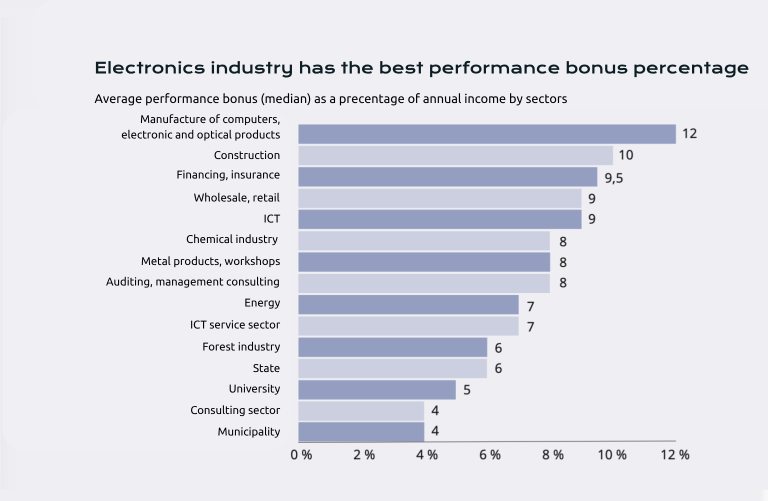
Senior managers and middle managers had seen a slight increase in their bonuses since the previous year, whereas the bonuses paid to employees in expert positions had remained static. The median size of performance bonuses was eight per cent last year, which was the same as during the previous year.